




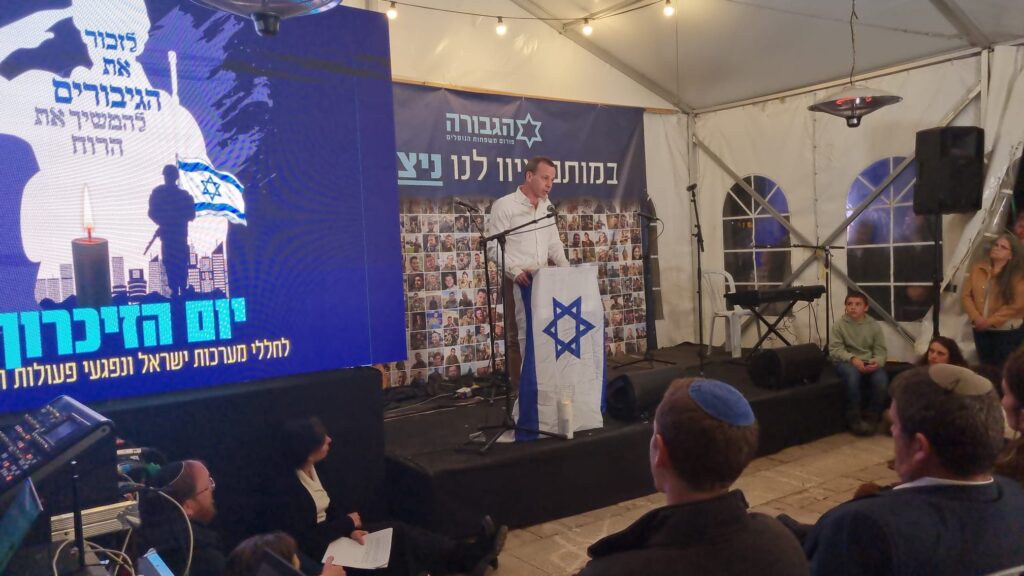
Two years ago, I happened to attend a Shabbat gathering of bereaved families in Tel Aviv. Usually, in a full synagogue, there are something like five Levites, one woman who recently gave birth, perhaps a Bar Mitzvah, and four people reciting the Mourner’s Kaddish.
But when they reached the Kaddish there, the entire synagogue—hundreds of congregants—stood up and said, “Yitgadal v’yitkadash shmei raba” (May His great name be exalted and sanctified). Because their loved ones fell on Simchat Torah of that year or in the months that followed.
I was reminded of another time something like this happened to me, in the synagogue at Hadassah Ein Kerem Hospital, a year prior. When suddenly a line formed of five or six fathers who had come to name their newborn daughters, alongside three circumcision ceremonies for sons.
And I thought about these places, seemingly opposites of one another. And about the painfully short distance between the naming of a child and the reciting of the Kaddish. For the fallen remain teenagers, or in their twenties, but in our eyes, as we grow older, they look younger and younger every time.
And I thought about how each and every one of these fallen soldiers was blessed at their circumcision with the words, “Sustain this child for his father and his mother.” And the child was sustained, until he decided, of his own absolute volition, to leap into the fire, in a country where people run toward the inferno as if running to the sea.
And afterwards, in the hall next to the synagogue, I passed by and caught a conversation I couldn’t believe could exist. Bereaved parents were debating when it is harder: when the fallen son leaves behind young orphaned children, or when he never had the privilege to do so. And I thought that perhaps we should say here too the prayer from the Day of Atonement: “We permit praying with the transgressors.”
Because we are all the transgressors who continue with our lives, with our quarrels. Transgressing every day the commandment “Do not forget” and the vow “To be worthy.” And perhaps here too, in our country, the time has come, from the last Memorial Day to this one, to lift all the boycotts and excommunications because of which—yes, because of them, too—this evil and this concealment of God’s face came upon us.
The fallen of this campaign—which still has no agreed-upon name and no end date—are nevertheless different from their predecessors. Because we did not imagine that in our generation, kids like Matan Abergil and Yochai Duchen would still jump on grenades. Or that even in an iPhone reminder, not just with a fountain pen, one could write words like those of Ben Zussman: “I am full of pride and a sense of mission, and I always said that if I have to die, I wish it to be in defense of others and the state. Jerusalem, I have posted watchmen, that the day will come and I will be one of them.”
But primarily because they went out to battle and did so with a clear mind. Despite long years of division and internal struggles, which supposedly should have erased any sign of willingness to die for people who think differently.
Regarding the First World War, an American author wrote, “A century of middle-class love was spent here in the trenches.” Here with us, heaven forbid, it was not squandered. And it is not a century old. It is a three-thousand-year-old love for this people and this place, stronger than any momentary struggle, passed from generation to generation, at an astonishingly early age. And as Yehuda Amichai wrote, “A man leaves a house, but the house does not leave the man.”
History will forget the political struggles and the momentary interests, but it will remember well how the tables turned between Simchat Torah 2023 in Be’eri and Passover 2026 in Tehran. It will distinguish between the essential and the trivial, and it will see light in the darkness of the “Cleared for publication by the IDF Spokesperson” announcements.
We did not invent this mixing of Memorial Day and Independence Day, which touch one another yet no realm encroaches upon its neighbor. 2,400 years ago, many Israelites stood on a mountain in Jerusalem at the dedication of the Second Temple. The young rejoiced over the Temple; the elders wept because they saw how modest it was compared to the First Temple they remembered. Naomi Shemer described it in the words: “Songs of lament, songs of praise, it mixes, it swirls.” And this is how Ezra described it:
And the people could not distinguish the sound of the joyful shout from the sound of the people’s weeping, for the people shouted with a great shout, and the sound was heard from afar.
During the Declaration of Independence, exactly 78 years ago tomorrow, Gush Etzion fell, and its defenders were massacred and taken captive. The death toll then crossed the two thousand mark just as the two-thousand-year-old hope was fulfilled. There was no house without mourning, and there was no street that did not fill with joy.
Alterman had already written eternal words about that hour:
“And the face of her joy is fierce/ And equally strong is the face of her sorrow/ And at the time of festival or lament they lie/ One at the door of the other/And the time is like a plowed field where they furrowed/ Love and hate and battle/ And the dust will burn until he arrives /He will come carrying his sheaves”
Alterman alluded to the verse: “Those who sow in tears shall reap in joy. He who goes forth weeping, bearing the seed for sowing, shall come home with shouts of joy, bringing his sheaves with him.” For unlike the Second Temple, when the Third Temple was established, it wasn’t that half wept and half rejoiced, but rather everyone wept and rejoiced together.
Most of us in the country acknowledge the miracle of the establishment of the State of Israel, yet fortunately, we have not experienced the terrible pain in our own flesh. On the other hand, there are those immersed in heavy mourning who cannot see the purpose for which it was required, and we have no right to judge them. But you sitting here acutely feel both the terrible sorrow and the spirit of history. These tectonic plates of sorrow and joy, memory and independence, these tectonic plates upon which the State of Israel sits, collide upon the tablet of your hearts every day and every hour.
You are the fault line. And within you is also the secret of the connection.
And I do not envy you, but I am jealous of your spirit. And like everyone else, I thank you from the depths of my heart and soul, and I ask for your forgiveness.
A week after the massacre, before the first rain, in Kibbutz Be’eri, they sowed the fields through which death galloped toward the homes. The biblical phrase “Those who sow in tears” was fulfilled in us quite literally. And if this part was fulfilled, it is guaranteed that the second part, “shall reap in joy,” will be fulfilled in us as well.