






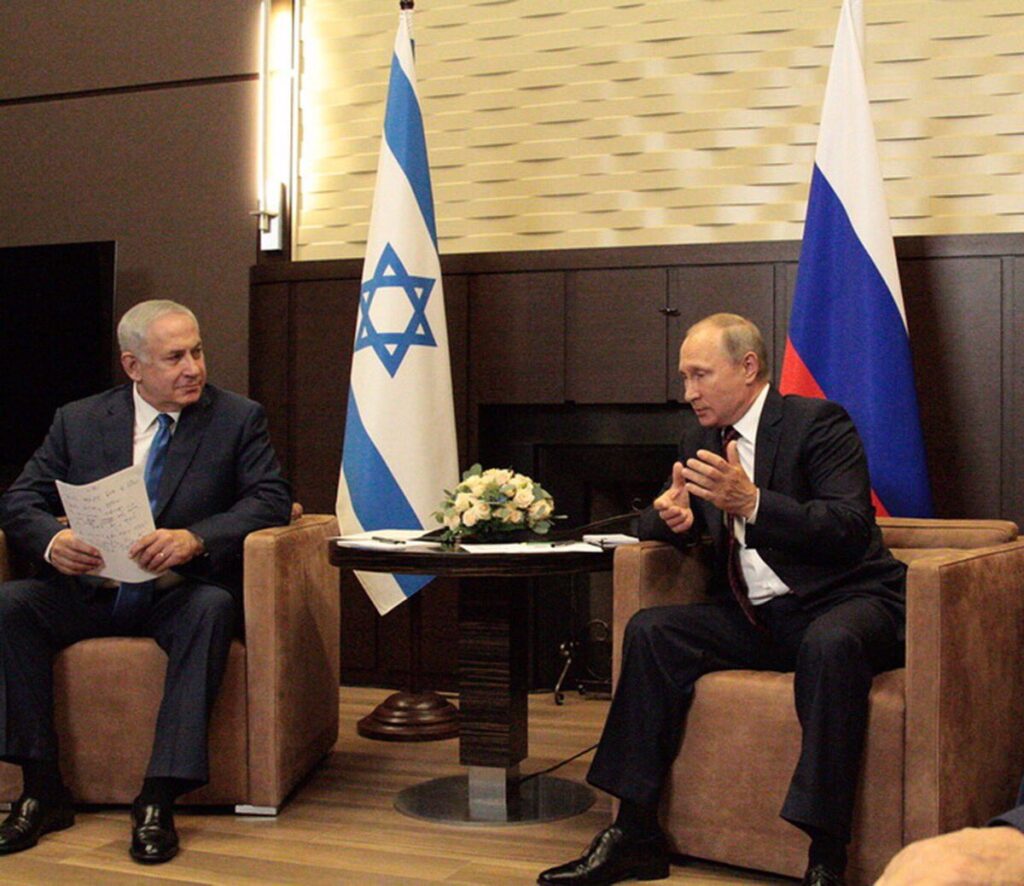
Every so often, a notice is published about a conversation between the president of Russia and the prime minister of Israel. It is usually brief, always laconic, and never details who called whom or what was said. As is well known, the public’s right to know is not Vladimir Putin’s guiding star.
In recent months, there have been at least two calls initiated by Jerusalem. Their subject was the delivery of a clear message: Israel has no interest in another round of military exchanges and certainly will not initiate one. In at least one case, the immediate trigger was warnings by Yisrael Beiteinu chairman Avigdor Liberman of an imminent clash with Iran. The Iranians are not versed in the irreparable rift between him and Netanyahu, or between Bennett and the government. From their perspective, when a former defense minister calls on the public to stay near protected spaces, and a former prime minister posts a tweet with sand running out of an hourglass (try explaining that it’s a countdown to a reservists’ conference), these are pre-attack signals. Those who were scalded by boiling water in June, when they failed to read all the clear signals—including an explicit tweet by the U.S. embassy—are now cautious even of the cold water of opposition statements. For them, every tweet by the two is like a Hamas SIM card lighting up.
Putin passed the message to the Iranians again and again. The impression here was that it was internalized and absorbed. But the regime’s enormous weakness, combined with post-trauma from “Rising Lions” still arouses concern. Were it not for that, one could say with confidence that Israel is not planning to strike soon. The unwillingness to be drawn into a cycle-based policy with Iran, together with the achievement of enlisting Trump also in the fight against ballistic missiles, plus American threats to intervene if the regime continues to murder protesters—all of these signal Israel to wait patiently on the sidelines. How much patience? The previous regime fell only after eleven months of protests. In Israel, they hope the digital age will accelerate processes, but estimate the timeline will not be measured in days, nor even weeks.
A more immediate and urgent matter is the expanding dispute extending to Lebanon and action against Hezbollah. The army has no shortage of aerial targets and would also be happy, on this occasion, to expand its ground presence to a few more commanding points. But the main question is, why hunt the mosquitoes if there is a chance that the swamp from which they drink is about to dry up anyway?
This is an excerpt from my weekly column in Israel Hayom