




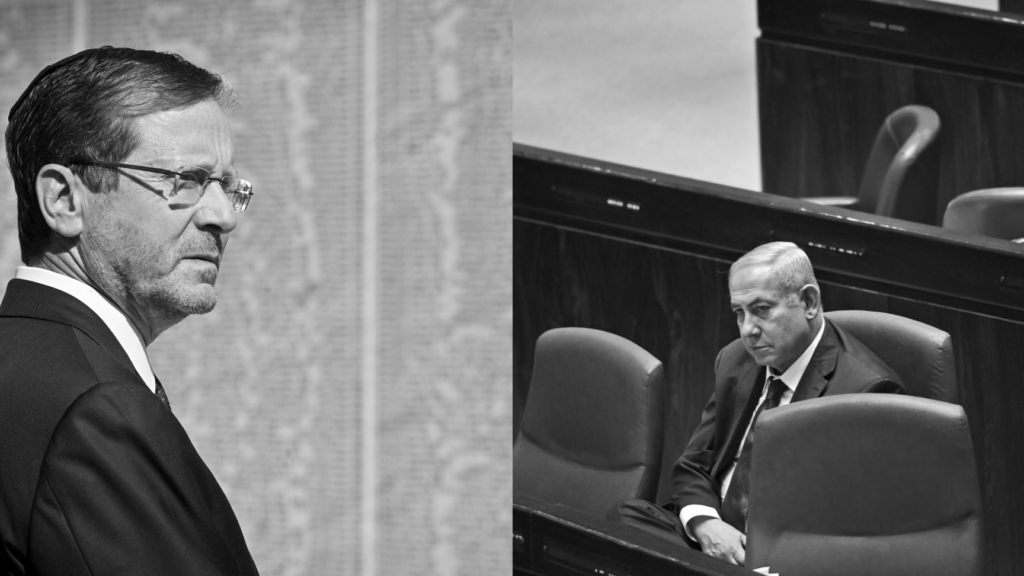
“God gave me this role at this moment,” President Isaac Herzog told Politico this week. But his dilemma regarding a pardon for Netanyahu is one even the devil himself couldn’t have devised. One camp believes the president’s historic role is to rescue Israel from a trial that should never have happened and that has turned our politics into a religious war. The other camp believes Herzog’s duty to future generations is to uphold the principle that “everyone is equal before the law.”
In short, an out-of-the-box framework is needed. Over the past week, the President’s Residence has turned into a laboratory of ideas — what the high-tech world calls a “hackathon”: everyone arrives with their own clever patent.
If I may also propose one, voluntarily: to craft a solution, one must first understand the problem.
In his pardon request, Netanyahu speaks of two key issues: the first is the rift in Israeli society, which the trial has deepened. The second is the diversion of the Israeli prime minister’s precious time in the middle of a period of unprecedented security and diplomatic risks and opportunities.
One of his well-known opponents told me this week that the rift will not heal if Netanyahu receives a pardon. Rather, in the eyes of the opposition it would deepen, as it will forever seem that he received an unfair advantage from the President’s Residence.
So, here is the proposal for how to have the cake and eat it too, more or less: Netanyahu was indicted in three cases. The gifts case — Case 1000 — considered by the prosecution to be the strongest and most muscular of them all. The conversations with Arnon Mozes — Case 2000 — for which the prosecution agreed to completely drop the charges as part of a plea deal. And the Bezeq-Walla affair — Case 4000. The court made its view clear when it recommended that the prosecution withdraw the bribery charge, but one of Herzog’s great frustrations, which led him to consider a pardon, is the prosecution’s proud refusal to even consider the recommendation, thereby prolonging the trial endlessly — and for no purpose.
The right step for the president to take is to pardon Netanyahu on the bribery charge in Case 4000 and the fraud and breach-of-trust charge in Case 2000. In doing so, he acts both beyond the strict letter of the law and within it. Herzog would essentially be giving presidential approval to what is nearly a legally established fact.
How does this serve the interests mentioned in Netanyahu’s request? It’s simple. Netanyahu has already finished testifying in Case 1000, and once he receives a pardon for the other two charges, his testimony would no longer be required, and he could devote himself fully to national duties. Even if a breach-of-trust charge remains in the Bezeq-Walla affair, his testimony could be spaced to once a week, avoiding the madness in which the IDF chief of staff meets with the prime minister until one in the morning on Sunday, because the next morning he starts three consecutive days of testimony.
This would not widen the national rift, because this is not a celebrity freebie. It would shorten the trial by more than a year, dramatically cut the time needed for closing arguments and the writing of the verdict, and lead to a faster judgment. Paradoxically, the pressure to reach a plea deal would only increase, because the moment of truth — with all the heavy risks it poses to both sides — would draw near. If the president cannot end this nightmarish film, he can at least press the fast-forward button.
This is an excerpt from my weekly column in Israel Hayom.