





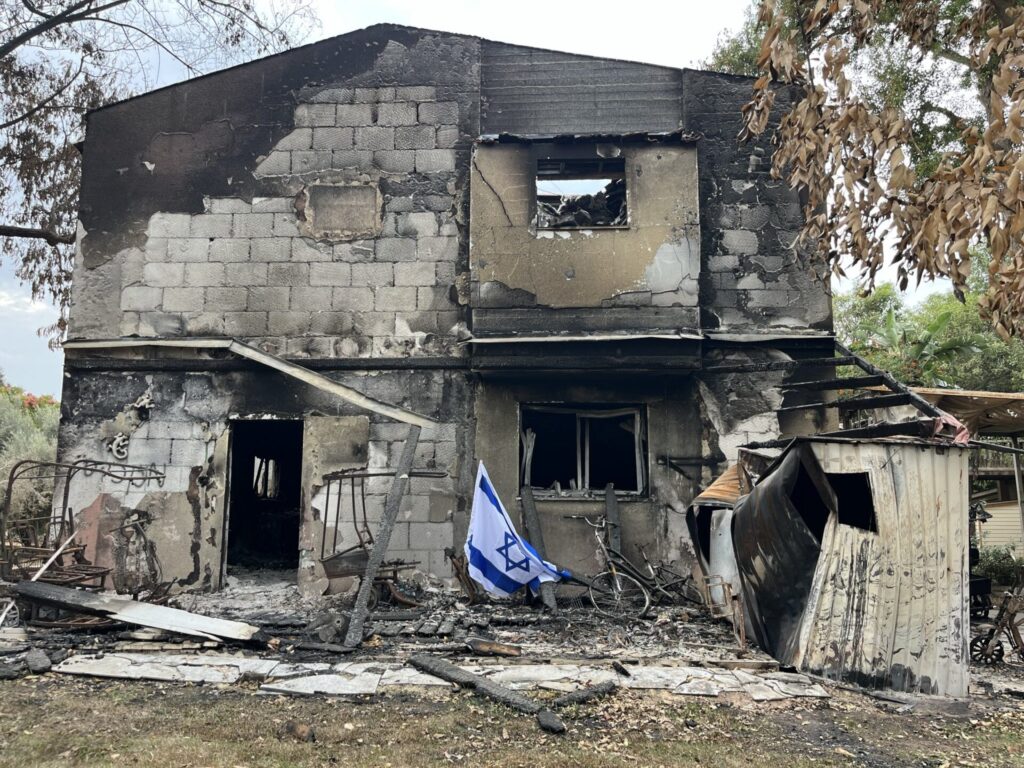
Rain dripped through the burnt roof beams of Amit Soussana’s house in Kibbutz Kfar Aza. Already in November 2023, a month after the massacre and Amit’s kidnapping, it was clear that not much would survive in the ruined homes without a comprehensive preservation plan.
More than two years have passed, and almost nothing has been done on the ground. Because even before the question of how to preserve, the question of whether to preserve arose. The residents of the three kibbutzim most devastated in the massacre — Be’eri, Kfar Aza, and Nirim — approached negotiations with the government with suspicion and mistrust. This is, after all, the government under whose watch they were slaughtered and kidnapped, and many in the kibbutzim did not want it or its representatives to determine how the massacre would be remembered.
This week, Kibbutz Be’eri voted on what and how to preserve. 102 members of the kibbutz were murdered by Hamas — a horrific number that put every option on the table, from preserving nothing to turning the entire kibbutz into a memorial site. By a vote of 196 to 146, they decided to preserve one house and demolish the rest. Another option discussed was moving the burned houses to the Nova festival site in Re’im with the same technique used to relocate the historic Sarona homes in Tel Aviv. Remembering and forgetting.
It is hard to characterize the identities of the “for” and “against” camps in a kibbutz where there is hardly a home without death. But residents noted that the main opposition to preserving more houses came from the Zeitim neighborhood, where many second-generation families with young children live. Their parents, who lived in the HaKerem neighborhood near the fence, were murdered in large numbers. The thought was that the grandchildren would not be able to run on the lawns with the smoking remains of their grandparents’ homes behind them. Others voiced a similar sentiment: “We don’t want to live in Yad Vashem.”
How can one argue with someone whose experience is so horrific? Among government critics and members of the kibbutz, some nonetheless believe differently. A well-known left-wing public figure visited Be’eri recently. “It’s no longer yours,” he gently told them. “It belongs to the people of Israel.” His words echoed what the American Secretary of War said at Abraham Lincoln’s deathbed: “Now he belongs to the ages.”
Is it possible to do both? One option proposed by the Heritage Ministry was called “the exception”: only the houses near the fence would be preserved, creating a buffer from the rest of Be’eri; perhaps even the kibbutz fence would be moved. This way, visitors could come to the preserved homes in their original location without walking through the kibbutz itself.
Even after the vote, nothing is final. It turns out that under Israeli law, the final decision does not necessarily belong to the kibbutz residents. The Antiquities Law states that an “antiquity is a human-made asset from 1700 CE and earlier, of historical value, which the minister has declared an antiquity.” The minister, the law says, may expropriate an antiquity site if expropriation is required for preservation or research. It is hard to think of late-20th-century kibbutz homes as “antiquities,” but on the other hand, there is no doubt that even hundreds of years from now the events of that Simchat Torah morning will be remembered.
It is a tragic circle: Antiquities Authority staff worked in the homes, using archaeological methods to locate the remains of victims whose traces were almost gone. Now they may return as visitors to a historic site.
Heritage Minister Amichai Eliyahu holds this authority. He faces several obstacles. The first: this clause has never been used. The second: Eliyahu is a rabbi from the Otzma Yehudit party, and such an action could be perceived as a forceful act of annexation and expropriation by a religious nationalist minister against secular kibbutzniks.
So Eliyahu is weighing the move. Perhaps others — those without a political stake or bias — should speak as well. For example, the President of Israel. This dilemma is not only that of Be’eri’s residents or the minister; it is all of ours.
This is an excerpt from my weekly column in Israel Hayom.