





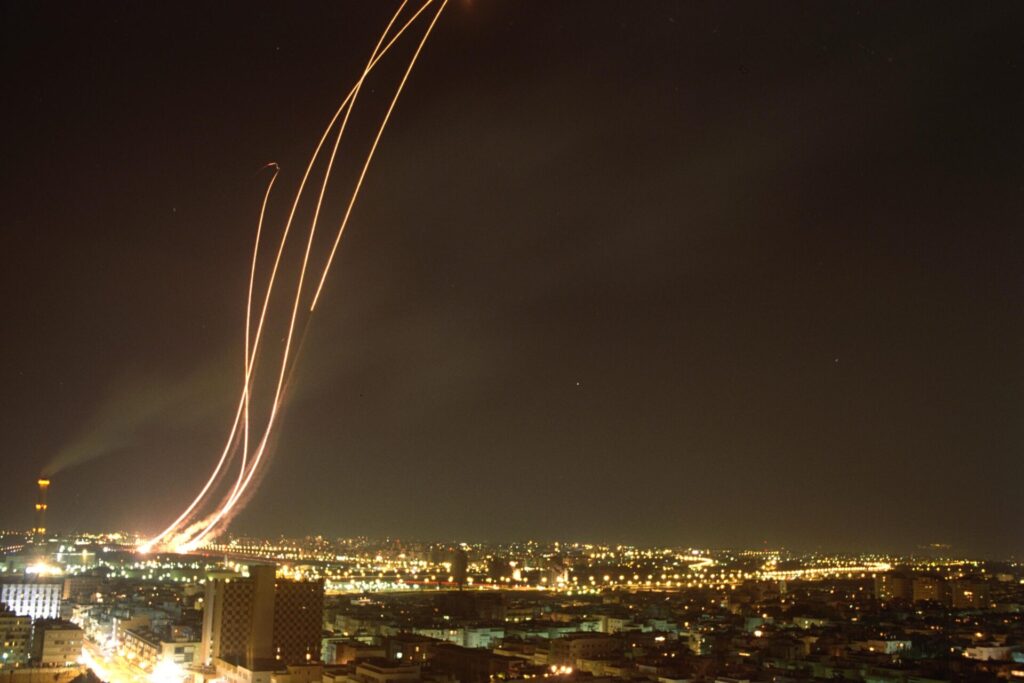
American interceptors launching to stop incoming Iraqi Scud missiles over the Tel Aviv in 1991. (GPO)
This is not the first time Israel has gone on high alert ahead of an attack by a Republican president on a dictator to our east. In 2003, for long months, panic gripped the country on the eve of the American invasion of Iraq. In the First Gulf War, Scud missiles fell on Israel, and the fear this time was that once Saddam realized he had nothing to lose, he would launch hundreds of such missiles—this time with chemical warheads. In the end it turned out that the chemical weapons never existed, and that dictators have two states of mind: in the first, they believe they will survive and therefore do not smash the furniture; in the second, they are already on the run, without the ability to strike back. The transition between the two is usually too fast to plan an attack on the “Little Satan”.
This is not the first time Israel has gone on high alert ahead of an attack by a Republican president on a dictator to our east. In 2003, for long months, panic gripped the country on the eve of the American invasion of Iraq. In the First Gulf War, Scud missiles fell on Israel, and the fear this time was that once Saddam realized he had nothing to lose, he would launch hundreds of such missiles—this time with chemical warheads.
In the end, it turned out that the chemical weapons never existed, and that dictators have two states of mind: in the first, they believe they will survive and therefore do not smash the furniture; in the second, they are already on the run, without the ability to strike back. The transition between the two is usually too fast to plan an attack on the “Little Satan.”
Despite the concerns here, there is no decision-maker in Israel who would not vote in favor of an aggressive American move against the ayatollahs’ regime. The potential damage pales in comparison to the benefits Israel would reap from the regime’s collapse. A senior figure in the system recently calculated how much money—and how many divisions—the IDF would save if a revolution were to occur.
Hezbollah’s collapse, he estimated, would happen within weeks, once the money for salaries, reconstruction, and weapons runs out. The organization’s fate in Lebanon would be bitter—not because of the IDF, but because of the Lebanese. Hamas would fall into a severe cash-flow crisis. The Houthis would not be eliminated, but their situation would also deteriorate. The Palestinian problem would not disappear, but it would no longer be fueled by money and weapons.
Without a nuclear project and the threat of ballistic missiles, vast sums could be redirected to other challenges. The immediate benefit to national security is estimated at 100 billion shekels. Amen.
What can Trump do? Perhaps take an interest in what Israel planned to strike on the very day he himself turned the planes back, a few hours after the cease-fire began. The operation our pilots were about to carry out would have caused a cascading, severe, unprecedented blow to regime targets. It would have produced, among other things, many columns of smoke in Tehran and deepened the damage to the institutions of a brutal government that represses the public.
“They don’t know what the hell they’re doing,” Trump raged to the cameras then, about Israel and Iran. Now he is on his way to doing something even bigger and more consequential.
This is an excerpt from my weekly column in Israel Hayom.